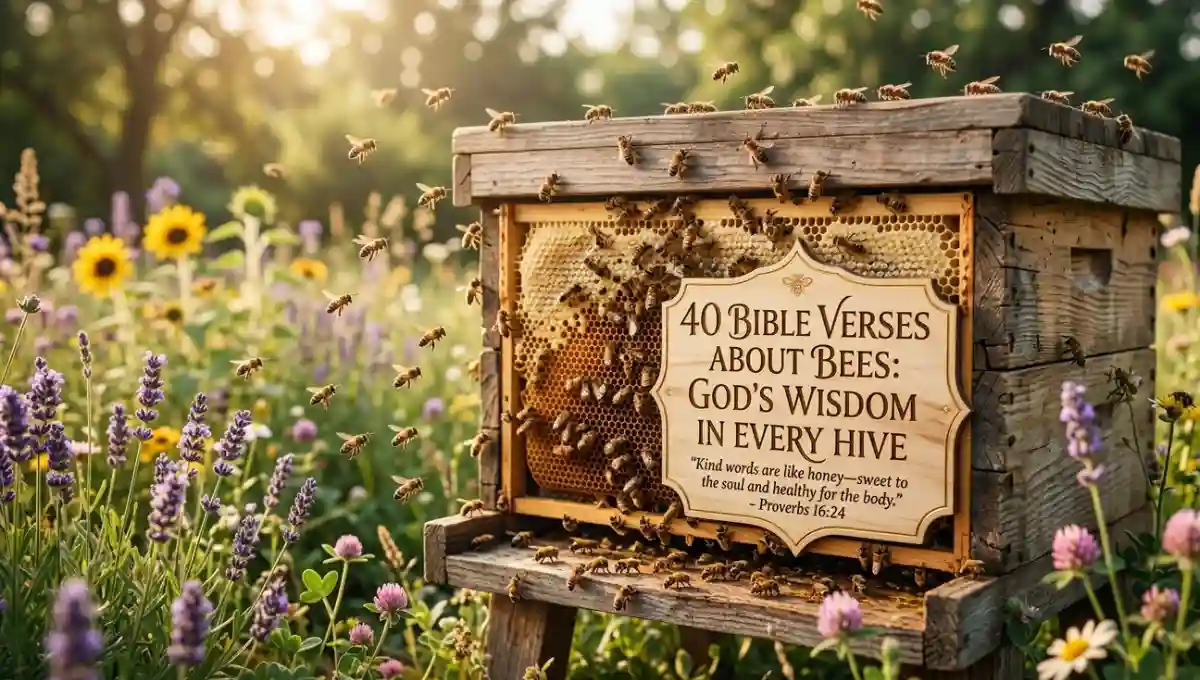
Few creatures in Scripture carry as much quiet significance as the bee. Small yet purposeful, bees appear throughout the Bible as symbols of God’s provision, divine order, and the sweetness of His Word.
Whether you are new to studying bees in the Bible or deepening your biblical understanding, this guide walks through 40 powerful Bible verses about bees, their symbolism, spiritual lessons, and much more.
Bible Verses About Bees
The Bible mentions bees both literally and metaphorically. Below are 40 key Bible verses about bees and honey, organized by theme for easy study and reference.
Direct References to Bees in Scripture
| # | Verse | Key Theme |
| 1 | Deuteronomy 1:44 | Enemies chased Israel like bees |
| 2 | Judges 14:8 | Samson finds a swarm and honey in a lion’s carcass |
| 3 | Judges 14:9 | Samson scoops out honey with his hands |
| 4 | Psalm 118:12 | Enemies surrounded the psalmist like bees |
| 5 | Isaiah 7:18 | God calls for bees from the land of Assyria |
Honey as God’s Provision
| # | Verse | Key Theme |
| 6 | Exodus 3:8 | The Promised Land flows with milk and honey |
| 7 | Exodus 16:31 | Manna tasted like wafers made with honey |
| 8 | Exodus 33:3 | God promises a land flowing with milk and honey |
| 9 | Leviticus 20:24 | The land of inheritance flows with milk and honey |
| 10 | Deuteronomy 8:8 | The land produces wheat, barley, vines, and honey |
| 11 | Joshua 5:6 | The promised land of milk and honey sworn to the fathers |
| 12 | 1 Samuel 14:25 | Wild honey was found on the ground |
| 13 | 1 Samuel 14:27 | Jonathan dips his staff in honeycomb; his eyes brightened |
| 14 | 2 Samuel 17:29 | Honey and curds given to sustain David’s people |
| 15 | 1 Kings 14:3 | A jar of honey given as a gift |
Honey as Wisdom and the Sweetness of God’s Word
| # | Verse | Key Theme |
| 16 | Psalm 19:9–10 | God’s Word is sweeter than honey from the honeycomb |
| 17 | Psalm 81:16 | God promises to satisfy His people with honey from the rock |
| 18 | Psalm 119:103 | God’s words are sweeter than honey to the mouth |
| 19 | Proverbs 16:24 | Pleasant words are a honeycomb, sweet to the soul |
| 20 | Proverbs 24:13–14 | Eat honey because it is good; so is wisdom for the soul |
| 21 | Song of Solomon 4:11 | Honey and milk are under the tongue of the beloved |
| 22 | Song of Solomon 5:1 | I have eaten my honeycomb with my honey |
| 23 | Ezekiel 3:3 | The scroll given to Ezekiel tasted as sweet as honey |
| 24 | Revelation 10:9 | The little scroll tasted sweet as honey |
| 25 | Revelation 10:10 | Sweet as honey in the mouth but bitter in the stomach |
Honey and Diligence: Work Ethic of the Bee
| # | Verse | Key Theme |
| 26 | Proverbs 6:6–8 | Go to the ant (and bee): observe, be wise, and diligent |
| 27 | Proverbs 10:5 | He who gathers in summer is a prudent son |
| 28 | Proverbs 12:11 | Whoever works his land will have plenty |
| 29 | Proverbs 14:23 | All hard work brings a profit |
| 30 | Proverbs 25:16 | Find honey? Eat just enough do not overindulge |
| 31 | Colossians 3:23 | Work at everything with all your heart, as for the Lord |
| 32 | 2 Thessalonians 3:10 | Those unwilling to work shall not eat |
Bees, Nature, and God’s Creation
| # | Verse | Key Theme |
| 33 | Genesis 1:24–25 | God made every creature and saw that it was good |
| 34 | Genesis 1:31 | God saw all that He had made; it was very good |
| 35 | Genesis 43:11 | Honey included in the gift sent to Egypt |
| 36 | Job 12:7–10 | Ask the animals and they will teach you |
| 37 | Deuteronomy 32:13 | God nourished His people with honey from the rock |
| 38 | Isaiah 7:15 | He will eat curds and honey when he knows enough to refuse evil |
| 39 | Matthew 3:4 | John the Baptist ate locusts and wild honey |
| 40 | Mark 1:6 | John wore camel’s hair and ate wild honey |
The Symbolism of Bees in the Bible
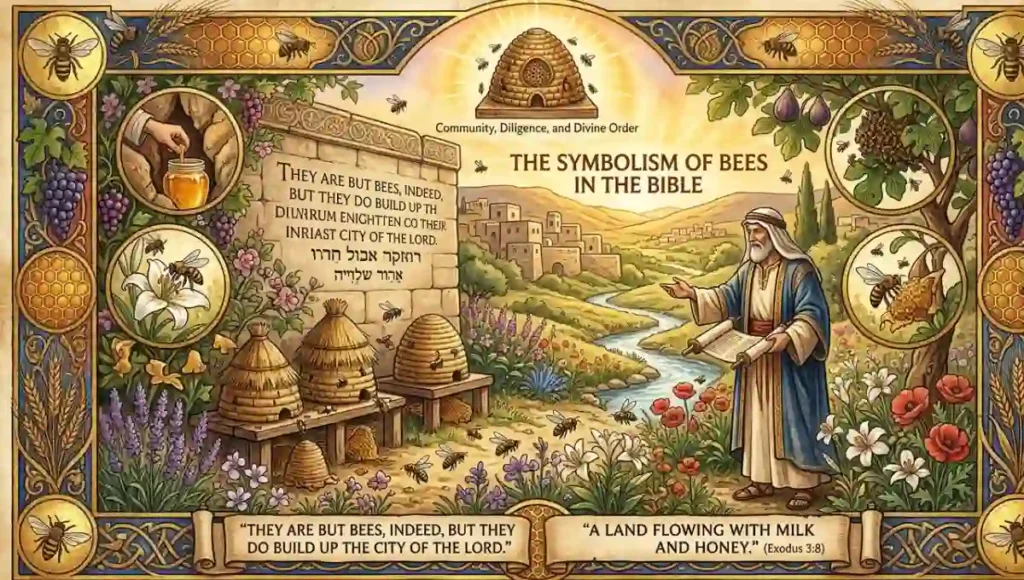
Bees in the Bible carry rich, layered meaning. They are never mentioned casually. Every reference reveals something deeper about God’s nature, His people, or His purposes.
Three primary symbolic roles emerge across Scripture:
1. Bees as a Force of Judgment In Deuteronomy 1:44, enemies chased Israel “like bees.” In Isaiah 7:18, God literally whistles for bees from Assyria as instruments of correction. This shows that even small creatures serve God’s sovereign plan.
2. Bees as a Sign of Abundance The Promised Land is described as flowing with “milk and honey” over 20 times in the Old Testament. Honey was not simply food. It represented fullness, blessing, and divine reward for obedience.
3. Bees as a Picture of Order and Community Early Christian scholars like St. Ambrose pointed to the beehive as a model of the Church. As noted in Christian tradition, “the beehive was seen as a metaphor for the Church, a structured and unified community built on cooperation, diligence, and purpose.”
The biblical symbolism of bees is inseparable from the symbolism of honeycomb and honey itself. Together, they form one of Scripture’s most complete pictures of God’s provision and wisdom.
Read Also: Olivia Name Meaning in Bible: A Message of Peace, and God’s Presence
Spiritual Lessons We Can Learn from Bees
God did not put bees in the Bible by accident. Every creature in creation teaches us something about the Creator. Here are the most powerful spiritual lessons that bees offer believers today.
Lesson 1: Diligence Is a Virtue
Bees never stop working. Worker bees clean the hive, gather nectar, feed young, and protect the colony all without complaint. Scripture consistently links diligence to blessing. Proverbs 14:23 says, “All hard work brings a profit.” The bee is a living sermon on this truth.
Lesson 2: Community Reflects God’s Design
A single bee accomplishes very little. But a hive of thousands produces something miraculous: honey. This mirrors the body of Christ, where every member plays a vital role. Bees remind us that God designed us for togetherness, not isolation.
Lesson 3: Sweetness Comes After Struggle
Samson’s famous riddle, “Out of the eater, something to eat; out of the strong, something sweet” (Judges 14:14), was born from finding honey inside a lion’s carcass. This is perhaps the Bible’s most powerful bee moment blessing arising from what was once a site of battle. It points directly to resurrection hope.
Lesson 4: Moderation Matters
Even honey, a good gift from God, must be eaten in moderation. Proverbs 25:16 warns, “If you find honey, eat just enough of it, and you will vomit.” Good things become harmful when consumed without wisdom. The bee teaches restraint just as much as abundance.
Lesson 5: Purpose Drives Productivity
Every bee knows its role. There is no confusion in the hive. This reflects God’s call on every believer’s life. When we understand our God-given purpose, we produce fruit that blesses others just as the bee’s labor produces honey for the whole colony.
Bees as a Sign of God’s Provision and Blessing
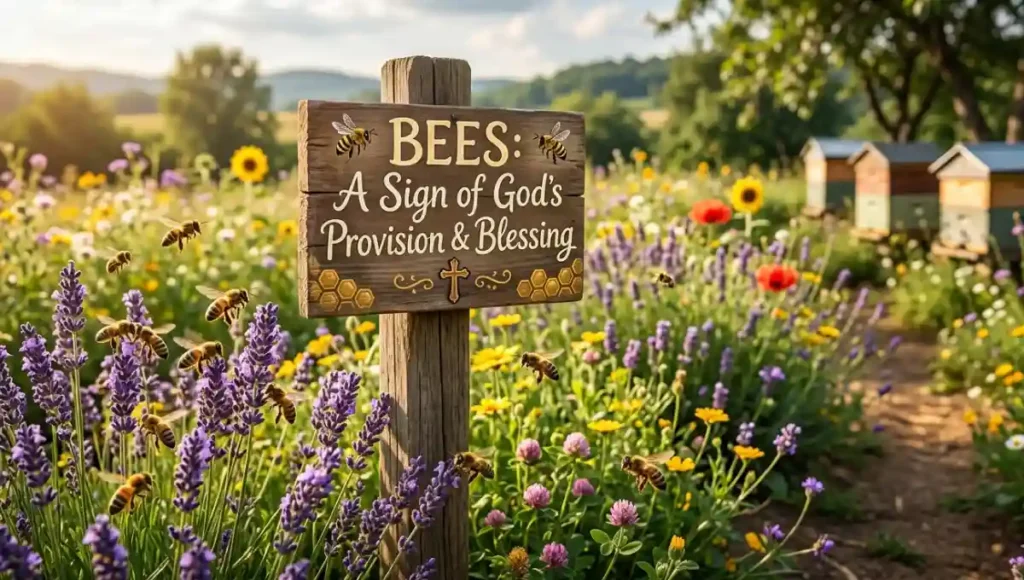
One of the most consistent themes connected to bees in the Bible is God’s extraordinary provision. The land flowing with “milk and honey” is mentioned no fewer than 20 times across the Old Testament. This phrase was not just a geographical description it was a covenant promise.
What “milk and honey” represents:
- Milk symbolizes nurturing, sustenance, and life.
- Honey symbolizes abundance, sweetness, and reward.
- Together, they paint a picture of a land where God’s people would lack nothing.
When God led Israel out of Egypt, He described their destination in Exodus 3:8 as a “good and spacious land, a land flowing with milk and honey.” The honey in this promise was directly tied to bees. Clay beehives estimated to be 3,000 years old have been discovered in Israel, confirming how central bees were to daily life in the biblical world.
God also fed His people with honey in the wilderness. Psalm 81:16 records this promise: “with honey from the rock I would satisfy you.” This is extraordinary. God drew honey from the most unlikely place, solid rock to show that His provision has no natural limits.
The spiritual takeaway is clear: wherever God calls you, He has already prepared sweetness there. His provision often comes from unexpected sources.
The Role of Bees in Biblical Agriculture and Daily Life
Bees were not simply spiritual symbols in Bible times. They were central to the agricultural economy of ancient Israel and the surrounding nations.
Key roles bees played in biblical daily life:
- Food production: Honey was one of the most valued food sources in the ancient Near East. It provided energy, sweetness, and long shelf life without refrigeration.
- Trade and commerce: Honey was a trade commodity. Genesis 43:11 records Jacob instructing his sons to take honey as a gift to Egypt during a famine.
- Medicine and healing: Ancient cultures, including the Israelites, used honey for its healing properties. Proverbs 16:24 recognizes this: “Pleasant words are a honeycomb, sweet to the soul and healing to the bones.”
- Religious offerings: Honey was considered a choice gift, fit for royalty and even used as a prophetic token (1 Kings 14:3).
- Beekeeping: Archaeological evidence confirms beekeeping was practiced in Israel as far back as 900 BC, showing that the “bee industry” was an organized part of Israelite society.
The importance of bees in biblical agriculture was not incidental. They sustained crops through pollination and provided one of the few natural sweeteners available in the ancient world. God, in His wisdom, built the ecosystem to depend on these tiny creatures just as He built the Church to depend on every member.
What Honey and Bees Represent in Scripture
Honey is one of the most theologically rich symbols in all of Scripture. It appears across the Law, the Prophets, the Psalms, the Wisdom literature, and even into the New Testament and Revelation. Understanding what honey represents helps us understand what God values.
Honey Represents the Word of God
The sweetest honey was compared to Scripture itself. Psalm 19:10 says God’s words are “sweeter than honey, than honey from the honeycomb.” Psalm 119:103 adds, “How sweet are your words to my taste, sweeter than honey to my mouth!” When Ezekiel was commanded to eat a scroll (Ezekiel 3:3), it “tasted as sweet as honey.” The Word of God, when received and savored, satisfies at the deepest level.
Honey Represents Wisdom
Proverbs 24:13–14 draws a direct parallel: “Eat honey, my son, for it is good… Know also that wisdom is like honey for you: if you find it, there is a future hope for you.” Seeking wisdom is like seeking honey. It takes work, but the reward is rich and lasting.
Honey Represents Divine Blessing
The consistent use of “milk and honey” as a metaphor for the Promised Land anchors honey as a symbol of covenantal blessing. When God gave Israel honey, He was signaling His faithfulness to His promises. The sweetness of honey was the taste of divine faithfulness.
Honey Represents the Sweetness of God Himself
Perhaps most beautifully, honey in Scripture points to the character of God. His words are sweet. His provision is sweet. His promises are sweet. Just as honey nourishes the body, God’s presence nourishes the soul. The bee, in producing honey through tireless work, becomes an unlikely portrait of a God who labors over creation for the delight of His children.
Our Thoughts on What the Bible Says About Bees
Studying Bible verses about bees has been a genuinely moving experience. What strikes us most is how God uses something as small and overlooked as a bee to carry some of His biggest theological themes.
Provision. Judgment. Wisdom. Diligence. Community. Blessing.
All of these themes flow through the simple image of a bee and its honeycomb. This is the beauty of Scripture: it wastes nothing. Every creature, every image, every verse is placed with intention.
We also find it remarkable that bees appear from the very beginning of Israel’s story (the Exodus promise) all the way to the prophetic visions of Ezekiel and Revelation, where the sweetness of honey represents the Word of God being received into the soul.
If you feel called to go deeper, we encourage you to sit with Psalm 19:10, Psalm 119:103, and Proverbs 16:24 this week. Let the sweetness of God’s Word settle over you like honey. Let it remind you that God’s instructions are not burdens, they are gifts, sweet to the taste and life-giving to the soul.
The humble bee has much to teach us. May we have the wisdom to learn.
Say This Prayer
Heavenly Father, thank You for the beauty and wisdom You have woven into every part of Your creation. Like the bee that works with purpose and produces something sweet, teach me to live with diligence, gratitude, and joy. Help me to treasure Your Word the way I would treasure the finest honey savoring it, living by it, and sharing it with others. Where I face struggle and difficulty, it reminds me of Samson’s riddle: that sweetness can come from the strongest, most unexpected places. May I trust in Your provision, work faithfully in my calling, and find the sweetness of Your presence even in the wilderness. In Jesus’ name, Amen.
Frequently Asked Questions About Bees in the Bible
Are bees mentioned in the Bible?
Yes. Bees are directly mentioned in at least four passages: Deuteronomy 1:44, Judges 14:8–9, Psalm 118:12, and Isaiah 7:18. Honey, which is inseparably linked to bees, appears over 60 times across both the Old and New Testaments.
What does honey symbolize in the Bible?
Honey in the Bible symbolizes the Word of God, divine wisdom, God’s covenant blessing, abundance, and the sweetness of His provision. It is one of Scripture’s richest and most consistently used symbols of goodness.
What do bees represent spiritually?
Spiritually, bees represent diligence, community, divine order, God’s provision, and the sweetness of walking in His ways. In Christian tradition, the beehive has historically symbolized the Church itself, many parts working together under one divine authority.
Why is the Promised Land called the land of milk and honey?
The phrase “land flowing with milk and honey” appears over 20 times in Scripture as a description of Canaan, the land God promised Israel. Milk pointed to fertile pastureland and animal abundance, while honey pointed to wild bee populations and agricultural richness. Together, they described a land where God’s people would thrive under His blessing.
What can Christians learn from bees?
Christians can learn five major lessons from bees:
- Diligence in work honors God.
- Community is God’s design for His people.
- Sweetness (blessing) often follows struggle.
- Even small things carry great purpose.
- Moderation is wisdom even good gifts must be received rightly.
Is John the Baptist connected to bees in the Bible?
Yes. Matthew 3:4 and Mark 1:6 both record that John the Baptist ate “locusts and wild honey” in the wilderness. His sustenance on wild honey connects him to the provision of God in the wilderness, mirroring Israel’s own experience of God’s supernatural care in the desert.
What is the biblical meaning of the honeycomb?
The honeycomb in Scripture represents the most concentrated form of God’s goodness is Word, His wisdom, and His blessing in their purest, most refined form. Psalm 19:10 specifically references “honey from the honeycomb” as the highest measure of sweetness, surpassing even pure gold.
Conclusion: God’s Wisdom Reflected Through Bees
The more we study Bible verses about bees, the more we see a God who speaks through every layer of creation. Bees in the Bible are not mere background detail. They are intentional, theologically loaded images that reveal God’s character, His promises, and His wisdom for how we should live.
From the earliest pages of Exodus where God promised His people a land full of honey to the final chapters of Revelation, where the sweetness of His Word is described as honey on the tongue, the bee carries God’s message across the entire arc of Scripture.
The biblical meaning of bees points us to three enduring truths:
God provides. He draws honey from rock, sweetness from lion carcasses, and blessings from the most unlikely places.
God values diligence. The bee’s tireless work is not incidental. It mirrors the character God wants to see in His people: faithful, purposeful, and productive.
God’s Word is the sweetest thing. Honey was the finest taste the ancient world could imagine. And yet, the biblical writers reached for honey as the closest comparison to the Word of God and even then, they said it fell short.
May you approach the Word of God with the reverence of someone tasting the finest honey. May you work in your calling with the purposefulness of a bee. And may you live in the community of faith with the unity of a thriving hive each doing your part, for the glory of the One who made both the bee and the honey it carries.

Welcome to BibleMsge! I’m Abdul Mannan Haider. Christian Faith Writer | 10+ Years Bible Study Experience | Founder of (BibleMsge.com)
Sharing prayers, biblical Name Meanings ,Bible Verses, Spiritual Meanings and biblical wisdom to strengthen your faith.